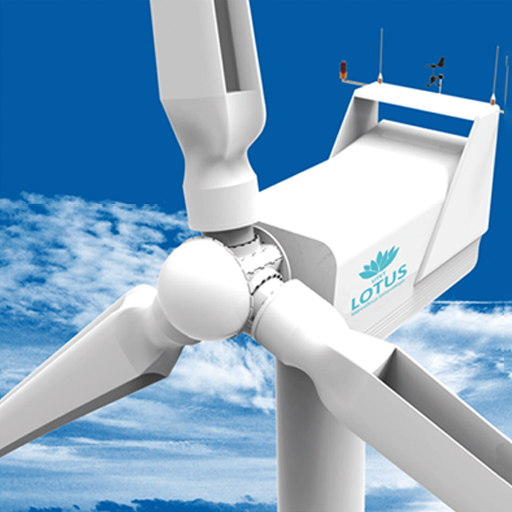
Lotus Horizontal Axis Wind turbines fully comply with accepted power curves. Scientifically accepted deviations and differences may occur in the power curves due to reasons such as terrain conditions, air density, and turbulence. The horizontal axis wind turbines we produce with our own blade design obtain 43% more energy than classical horizontal axis wind turbines and operate much more quieter than other wind turbines. The blade diameter of the Lotus horizontal axis wind turbine is 100-120 cm (1-1.5 kW).
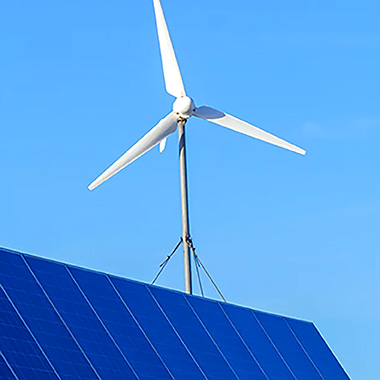
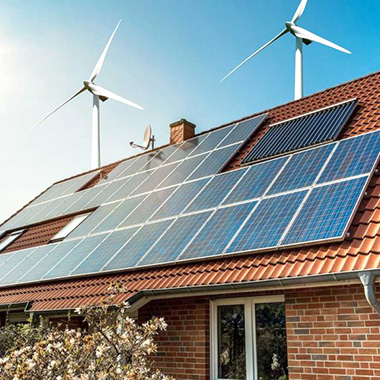
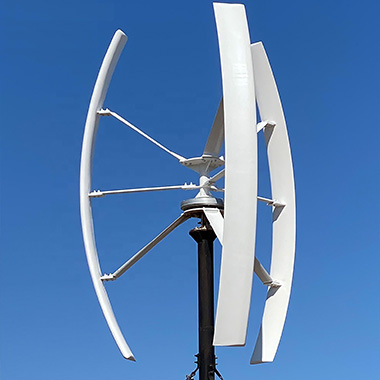
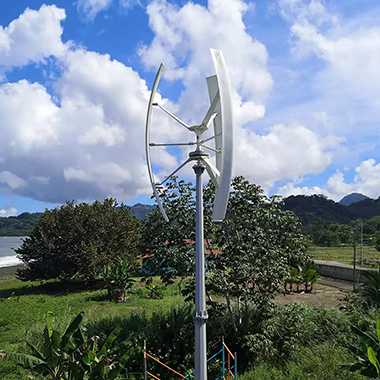
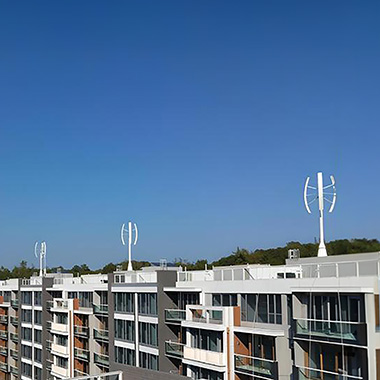
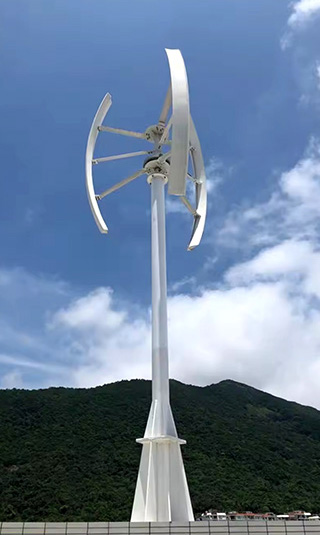
Alternatively, we also have vertical axis wind turbines. These products, with a wing height starting from 90 cm, do not create visual disturbances on roofs. Vertical axis wind turbines can be placed in a zigzag pattern or one meter apart, depending on the dimensions of the roof to avoid interruption each other's wind. Our turbines start from 40 kg in weight and operate 30% more efficiently than other vertical wind turbines. Vertical axis wind turbines generally operate more quietly than horizontal axis wind turbines.
| 3 kW Horizontal Wind Turbine Energy Production | ||
|---|---|---|
| Wind Speed (m/sec) | Power (kW) |
Yearly Production (kW) |
| 3 | 25.34 | 196 |
| 4 | 52.94 | 464 |
| 5 | 103.42 | 905 |
| 6 | 178.72 | 1565 |
| 7 | 283.80 | 2486 |
| 8 | 423.64 | 3711 |
| 9 | 603.19 | 5284 |
| 10 | 827.42 | 7248 |
| 11 | 1101.29 | 9647 |
| 12 | 1429.77 | 12525 |
| 13 | 1817.83 | 15924 |
| 14 | 2270.43 | 19899 |
| 15 | 2792.53 | 24462 |
| 16 | 3389.10 | 29688 |
| 1.5 kW Vertical Wind Turbine Energy Production | ||
|---|---|---|
| Wind Speed (m/sec) | Power (kW) |
Yearly Production (kW) |
| 2 | 5.54 | 48.55 |
| 3 | 18.70 | 163.81 |
| 4 | 44.33 | 388.33 |
| 5 | 86.69 | 758.53 |
| 6 | 149.63 | 1310.70 |
| 7 | 237.60 | 2081.40 |
| 8 | 354.67 | 3006.90 |
| 9 | 505 | 4423.80 |
| 10 | 692 | 8076.70 |
| 11 | 922 | 9687 |
| 12 | 1197 | 10486 |
| 13 | 1522 | 13333 |
| Wind Turbines | ||||||
|---|---|---|---|---|---|---|
| Turbine Model | Wing Diameter | Hub Height | Start Wind Speed | Nominal Wind Speed | Alternator Voltage | Inverter |
| 500 Watt Horizontal | 1.75 lm | 6 - 12 - 18 (opt) | 2 m/h | 9 m/h | 12 - 24 - 48 VDC adjustable | 28 VDC/220 VAC 50 Hz |
| 1 kW Horizontal | 2.50 lm | 12 - 15 - 18 (opt) | 2 m/h | 10 m/h | 12 - 24 - 48 VDC adjustable | 28 VDC/220 VAC 50 Hz |
| 2 kW Horizontal | 3.40 lm | 12 - 15 - 18 (opt) | 2 m/h | 10 m/h | 48 - 500 VDC adjustable | 28 VDC/220 VAC 50 Hz, 500 VCD/380 VAC 50 Hz |
| 3 kW Horizontal | 5.00 lm | 12 - 15 - 18 (opt) | 2 m/h | 10 m/h | 48 - 500 VDC adjustable | 28 VDC/220 VAC 50 Hz, 500 VCD/380 VAC 50 Hz |
| 500 W Vertical | 1.75 lm | 6 - 12 - 18 (opt) | 2 m/h | 9 m/h | 12 - 24 - 48 VDC adjustable | 28 VDC/220 VAC 50 Hz |
| 1.5 kW Vertical | 2.00 lm | 6 - 12 - 18 (opt) | 2 m/h | 10 m/h | 12 - 24 - 48 VDC adjustable | 28 VDC/220 VAC 50 Hz |
Alternatively, we also have models that produce 5 kW and 10 kW power in Horizontal Wind Turbines, and 2 kW, 3 kW, 5 kW and 10 kW power in Vertical Wind Turbines. Please contact for technical data.
Noise levels of Horizontal Axis Wind Turbines (HAWTs) and Vertical Axis Wind Turbines (VAWTs), are influenced by several factors, including design, size, and operational conditions. Here's a general comparison of the noise levels (in decibels, dB) for 2 kW and 3 kW HAWTs and VAWTs.
Horizontal Axis Wind Turbines (HAWTs):
2 kW Horizontal Wind Turbines: Typically, the noise level is around 40-55 dB at a distance of about 10 meters. The noise level can increase slightly when the wind speed increases, as the blades spin faster.
3 kW Horizontal Wind Turbines: The noise level is slightly higher, ranging from 45-60 dB at a similar distance. Larger and more powerful HAWTs tend to produce more noise due to increased blade speed and rotor size.
Vertical Axis Wind Turbines (VAWTs):
2 kW Vertical Wind Turbines: Generally, Vertical Axis Wind Turbines are quieter than Horizontal Axis Wind Turbines, with noise levels ranging between 35-50 dB at 10 meters. The reduced noise is primarily due to lower rotational speeds and different blade aerodynamics.
3 kW Vertical Wind Turbines: The noise level is typically around 40-55 dB. Although VAWTs can be noisier at higher capacities, they usually remain quieter than their HAWT counterparts.
| Lotus 3 kW Vertical Wind Turbine | |
|---|---|
| Wind Speed (m/s) | Sound (dB) |
| 3 | 1.33 |
| 4 | 3.09 |
| 5 | 6.22 |
| 6 | 9.45 |
| 7 | 13.24 |
| 8 | 22.39 |
| 9 | 31.55 |
| 10 | 36.45 |
| 11 | 37.22 |
| 12 | 45.38 |
| 13 | 45.29 |
| 14 | 45.38 |
| 15 | 45.43 |
| 16 | 45.59 |
Factors Affecting Noise Levels:
Design and Blade Shape: Horizontal Axis Wind Turbines often have longer, faster-moving blades, which can generate more noise compared to the slower, more aerodynamically shaped blades of Vertical Axis Wind Turbines.
Wind Speed and Turbulence: Higher wind speeds and turbulent air can cause increased noise in both types of turbines.
Operational Frequency: Horizontal Axis Wind Turbines typically generate a swishing noise due to the blades passing the tower, while Vertical Axis Wind Turbines often produce more of a humming or whooshing sound.
Summary:
Horizontal Axis Wind Turbines are generally louder than Vertical Axis Wind Turbines due to their operational characteristics and design.
The increase in capacity from 2 kW to 3 kW results in a moderate increase in noise, typically in the range of 5-10 dB.
For urban or noise-sensitive areas, Vertical Axis Wind Turbines are generally preferred due to their lower noise profile.
These values can vary slightly depending on the specific model, installation, and environmental conditions.
Wind turbines come in two primary designs: horizontal axis wind turbines (HAWTs) and vertical axis wind turbines (VAWTs). These designs serve different purposes and are optimized for different environments, so understanding their key differences is important when deciding which type to use.
Design: These turbines have a rotor and blades that rotate around a horizontal axis. The most common example is the classic three-blade wind turbine seen in many wind farms.
Blade orientation: The blades are positioned facing into the wind, and the entire turbine turns (or "yaws") to face the changing wind direction.
Key Features:
Efficiency: HAWTs are highly efficient, especially in areas with consistent and high wind speeds. They capture wind energy more effectively compared to vertical turbines.
Size: Typically larger, with blade lengths that allow them to capture more wind energy.
Height: HAWTs are usually installed on tall towers to reach stronger and steadier winds.
Use Case: They are ideal for utility-scale wind farms in open areas with high, steady wind conditions (e.g., coastal areas, flat plains).
Maintenance: Because the mechanical components (gearbox, generator) are at the top of the tower, maintenance can be more complex and expensive.
Advantages:
High efficiency in capturing wind energy.
Larger sizes allow for more power generation.
Drawbacks:
Needs constant yawing to face the wind direction.
Requires more space and taller towers.
More complex and costly maintenance, particularly due to tower height.
Design: VAWTs have a vertical rotor and blades that rotate around a vertical axis. They can take different shapes, like the egg-beater (Darrieus) or the helical (Savonius) designs.
Blade orientation: The blades spin around the central shaft regardless of wind direction, so they don’t need to reorient themselves to face the wind.
Key Features:
Wind direction independence: VAWTs do not need to align with the wind, which is useful in environments with varying wind directions (like urban areas or turbulent wind sites).
Smaller size: They are typically smaller than HAWTs and can be placed closer to the ground.
Use Case: Suitable for urban or suburban areas, locations with turbulent or shifting winds, or where space is limited.
Maintenance: Maintenance is easier and cheaper because most components are at or near ground level.
Advantages:
Simple design, easier maintenance.
Works in areas with inconsistent wind directions.
Requires less space, can be installed in more compact areas.
Drawbacks:
Generally less efficient than HAWTs in high-wind, steady conditions.
Smaller size means less power generation.
| Feature | Horizontal Axis Wind Turbine (HAWT) | Vertical Axis Wind Turbine (VAWT) |
|---|---|---|
| Efficiency | High, especially in steady winds | Lower, suited for areas with variable winds |
| Wind direction handling | Needs to face the wind, requires yawing | Captures wind from any direction |
| Size | Large, often taller | Compact, often shorter |
| Maintenance | Complex, requires work at high elevations | Simpler, with easier ground-level access |
| Space requirement | Requires more space (open, rural areas) | Less space needed, suitable for urban use |
| Cost | Higher installation and maintenance costs | Lower installation costs, cheaper maintenance |
| Power generation | Higher output, suitable for large-scale energy | Lower output, more suitable for small-scale use |
The decision to use a horizontal or vertical axis turbine depends on several key factors:
HAWTs are best for locations with consistent wind patterns and high wind speeds.
VAWTs work better in areas with variable wind directions, lower wind speeds, or turbulent winds (e.g., near buildings or mountains).
HAWTs require larger open spaces (rural areas, fields, offshore), while VAWTs can be used in more confined or urban environments.
If large-scale energy production is the goal (e.g., for wind farms), HAWTs are more suitable.
For smaller-scale applications like residential areas, farms, or off-grid power, VAWTs may be a better fit.
HAWTs are generally more expensive to install and maintain due to their size and complexity.
VAWTs, with simpler designs and ground-level components, have lower costs in these areas.
In urban environments where aesthetics, noise, and wildlife impact are concerns, VAWTs are often preferred due to their smaller size and quieter operation.
HAWTs are ideal for high-energy, large-scale wind farms in open areas with consistent wind.
VAWTs are better suited for smaller applications or areas with turbulent winds, variable directions, or space constraints.
When deciding which to choose, consider wind conditions, space availability, cost, and the energy output required. Lotus has both types of wind turbines and is able to produce proper sizes to fit your energy requirements.

